Well, not literally, perhaps, but darned close. Living down here in Dayton, I see a huge number of posts on the Ohio Birding list from the northwestern corner of the state during this time of year. I get a little jealous. Especially with today's fantastic gas prices, driving to Magee Marsh, Crane Creek, Metzger Marsh or Ottawa Nature Reserve is just out of the question for me. It makes me a little sad, especially when I see posts about the 24+ species of warbler that person X saw or the copious number of shore birds that person Y saw. So, I've always regarded Magee Marsh as a sort of Mecca for my birding religion. I had also thought I would probably never have a chance to get up that way -- especially during migration. Thankfully, I was wrong. Through an odd twist of fate, I ended up taking the boys to Sandusky for the weekend, of which I got Friday as my "your choice" day. Guess where we went...
The first thing I noticed when we stopped at the visitor center and took the  opening loop trail was how most of the traffic kept driving. I figured they were heading to the boardwalk. I was right. That was OK, though, because it meant that the boys and I had the trail, basically, to ourselves. We were able to get some good looks at some Yellow Warblers, and I think it made Connor's day to come almost nose to nose with a young deer. We saw a Swainson's Thrush walking around just off the parking lot and decided we should probably go find the boardwalk.
We got back in the car and followed the throng (well, OK, 3 other cars headed that direction) to a large, expansive parking area that was about 1/3 full, already, at 9am. There were birders all over the place, wandering around the parking lot paying no attention to incoming traffic or other humans, but with head at a 45-degree angle (or more acute!) looking into the trees, with or without scopes. Even from that scene, I was impressed. Imagine how deeply I was impressed when I rounded the corner onto the boardwalk and saw close to 150 people all jammed into about a 30-yard by 5-foot area, some pouring up the stairs to a platform, some merely hanging out on the stairs, all with attention trained on the trees.
Imagine also how deeply I was impressed with the number of Canon 1DS Mark IIIns with either 500mm f/4 or 600mm f/4 lenses. There  were several, and I was impressed. However, I learned a couple of reasons why my 200-500mm f/5-6.3 lens was actually a better choice for the birding. I know -- you still want the big, fast glass when you've got a cute, little bird holding perfectly still and allowing you to train your telescope on them to get a full-frame shot of said small, cooperative bird. The main problem? When was the last time a Blackburnian Warbler sat still? Bingo. I found myself standing next to a 600mm f/4 mounted on a tripod (I was going handheld, iso800, f/5, 1/80-1/160) and observed that as I was able to spot birds,
  train the lens on the spotted bird and fire off a couple of rounds of shutter releases on aforementioned bird, big lens guy was basically sitting there, unmoving. I didn't think much of this...except it kept happening. So, I wondered to myself why this was. Then I watched the "why" in action. A Blackburnian Warbler lit on a tree and held relatively still, only hopping about once every 10 seconds. I rattled off 5 shots, 2 of which were useable (combine low light and a continually moving target and you get some blur...). Large lens guy rattled off no shots, but rather spent the entire time the bird was
  visible trying to train that large lens on it. By the time he had the bird lined up, the bird's attention span had been eclipsed by the desire to do something else, and had gone to visit the thrilled birders on the other side of the boardwalk. I didn't hear swearing, but you could kind of see it on his face. I no longer suffered from lens envy. In fact, I got the stink eye, when I rattled off more shots, capturing the Black and White Warbler that landed, turned upside down for me, then flew away....before he could even track the bird with the lens.
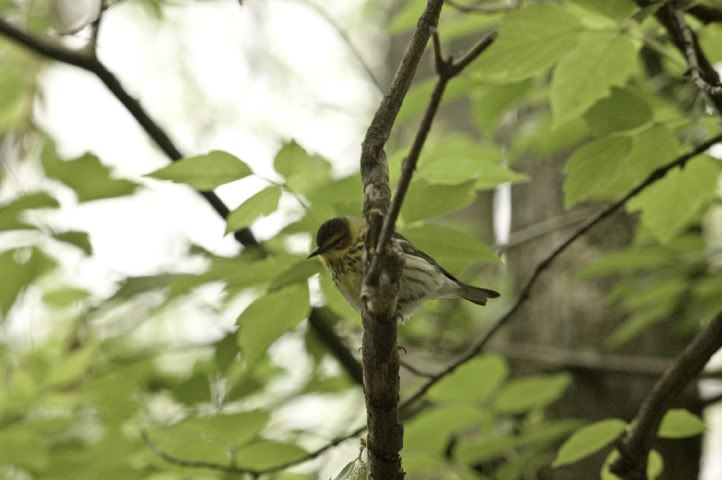
Anyway, this was, bar none, the best bird photography experience I have ever had. It was a little frustrating, at first, because of the low light conditions and the sheer number of people. It was hard to get a good place to set up for decent photographs. That said, once  we figured that part out, the most frustration Alex and I had was when the Cape May Warbler landed, literally, two feet above my head and was too close on which to focus...wacky! That didn't stop us, though, as we backed up a little and got some beautiful pictures of this cute warbler. I haven't gone through all the photographs, yet, as there are around 160, but the one I posting is from the initial conversions of photographs. It's not the best of the bunch, I don't think, but it illustrates the harsh backlighting we were working with as well as how close these little puppies were actually landing.
I know the fellow with the 500mm f/4 with the large directed flash had better luck, but it was still, by and large, dictated by the benevolence of the bird. Now that I think about it, though, with the close birds...I should have used my on-camera flash, which, even with the 200-500mm lens, would definitely helped a lot. Next time, should there be a next time. In fact, I'm looking at the SB-800 with a Visual Echoes Flash Extender...roughly what I saw attached to all the Canon bodies.
Once off the platform and past the initial clogging, there was some open space and some open looks at some beautiful birds. What struck me, though, was how little I was bothered by the copious  numbers of other people -- birder or otherwise -- bothered me. For those who know me, you all know that I do as much as humanly possible to be the only person wherever I am and can't abide by human contact when I'm trying to be "in the zone." I'm getting better, I really am, but this is something that's been the case since I started birding back in college...to be more specific, at Pine Hills or Turkey Run, starting in roughly 1992. In 1992-93, I would head out to Pine Hills at 6am, even after having gone to bed at 4... just to avoid other people. I'm not quite that psychotic, now, but I still have that need to be alone, sometimes. With that in mind, it was really neat to be surrounded by that mu
 ch love for birding and/or photography. There was a palpable excitement that was contagious when the Blackburnian Warbler made his appearance, or the Cape May Warbler landed in the tree above our heads. That was cool.
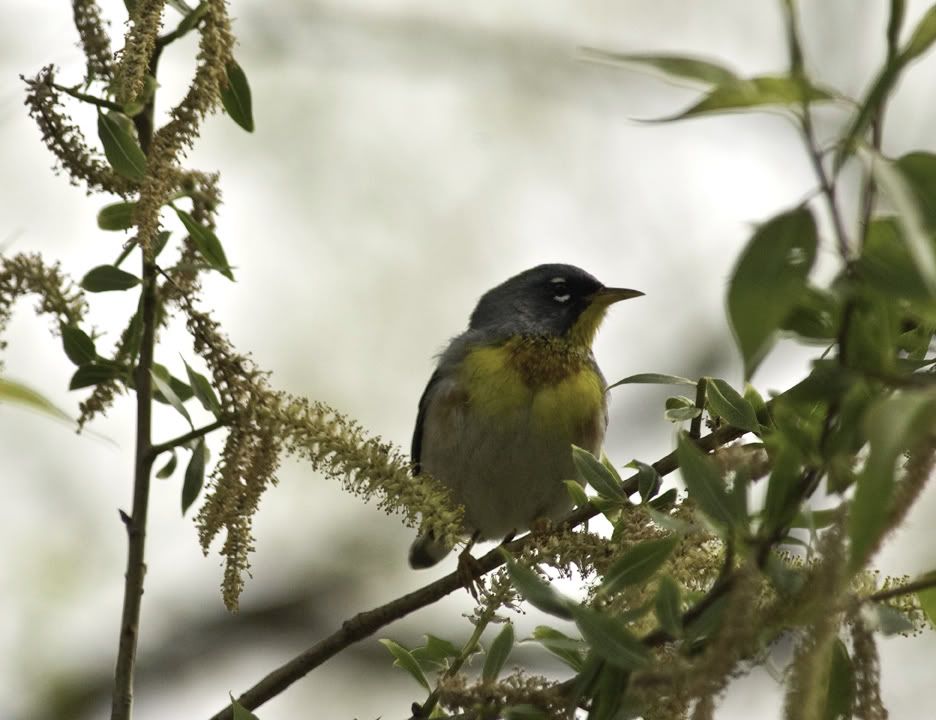
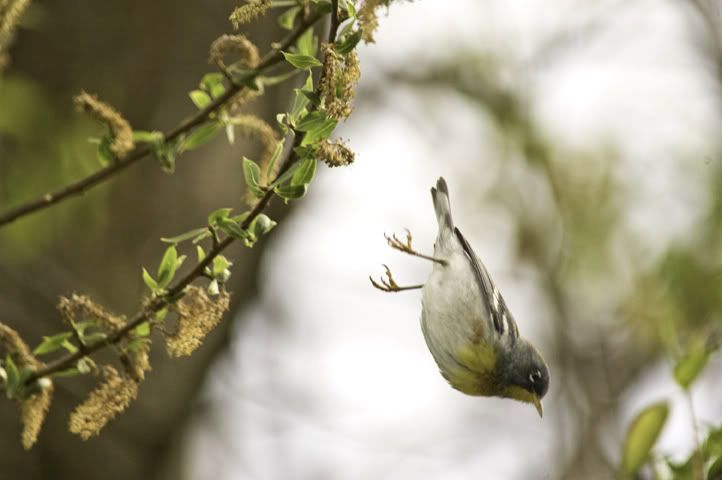
I think the most amazing part of the experience, for me, was the sensation of seeing a "life bird" and being able to photograph it at the same time. Another was being able to photograph those birds that had proven to be really elusive back home. I'm particularly happy with the Northern Parula pictures, as they don't hold still very  much, and this time I managed to get some good photographs -- including one that I've just become enamored with: it looks like the Parula has just decided to end it all. Funny. I wish I that I could go back with flash, though, in order to get some better pictures that weren't ramped up to iso800.
All in all, my first experience at Magee Marsh can be summed up in one word: amazing. It makes me that much angrier at the gas prices, now, because if it weren't for $4/gal prices, I would do whatever I could to get back up there soon. As it stands, I shudder to think how long a 3.5 hour drive in the car would translate to a bike ride. Who wants to carpool??